Wooden partitions can define a living room without the heaviness of a permanent wall. They are useful in open-plan apartments, villas, and renovated homes where the entrance, dining area, staircase, or prayer space needs visual separation. The right partition provides privacy while preserving light, ventilation, and a sense of openness.
For homes in Coimbatore, the design should also be easy to maintain and proportionate to the available room.
Vertical Wooden Slat Partitions
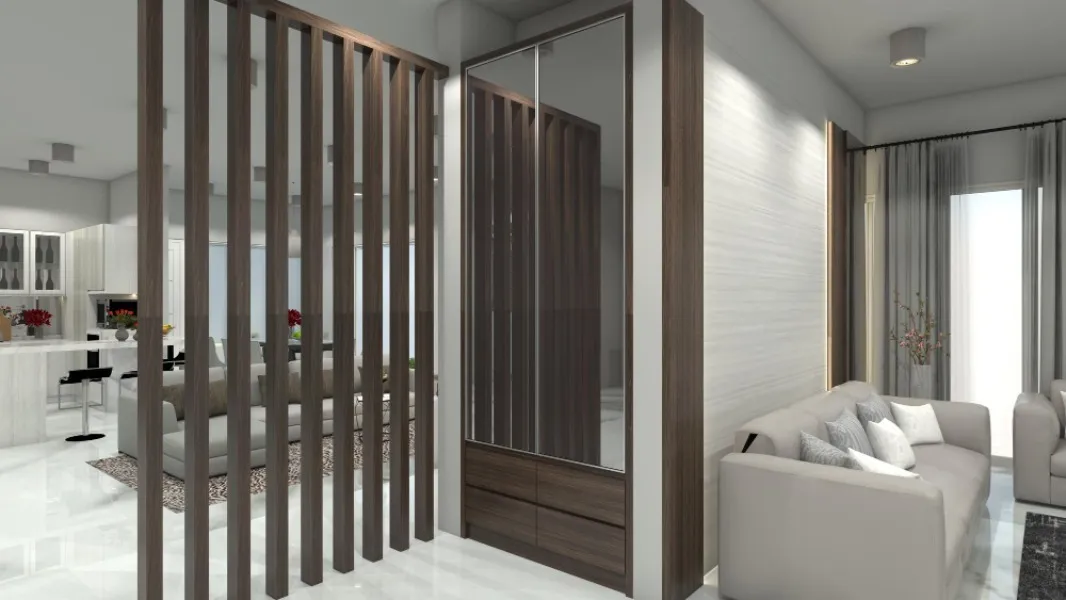
Vertical slats are well suited to modern interiors because they create separation without completely closing the view. The spacing can be adjusted according to the level of privacy required.
Slats may extend from floor to ceiling or be installed over a low storage cabinet. Wider gaps keep the room open, while closer spacing creates stronger screening.
The slats need secure fixing at both ends. Their alignment should be checked carefully because even small inconsistencies become noticeable across a large installation.
Partition with Display Shelves
An open shelving partition can hold books, ceramics, plants, or decorative objects while dividing two areas. It works particularly well between living and dining zones.
The shelves should not be overloaded with small objects. Excessive display creates clutter and reduces the airy quality of the partition. A combination of open niches and a few closed cabinets can provide both visual interest and practical storage.
Shelf depth should be appropriate for the items being displayed without projecting unnecessarily into the walkway.
Entryway Partition with Shoe Storage
Homes with a direct view from the entrance into the living room may benefit from a foyer partition. A wooden screen can provide privacy while a lower cabinet stores footwear, keys, and daily accessories.
This type of unit should allow comfortable door movement and preserve a clear entrance passage. Ventilation is important if footwear is stored inside closed cabinets.
A small ledge or drawer can provide a convenient place for keys without adding a separate console table.
Fluted and Ribbed Wooden Panels
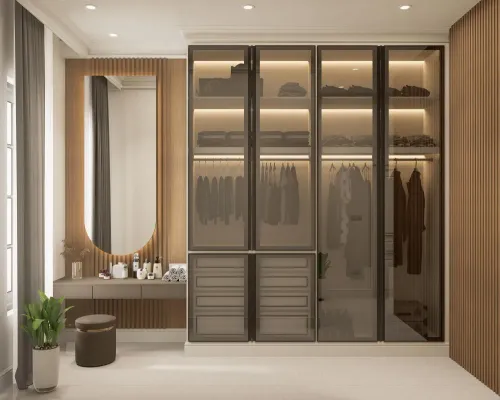
Fluted panels introduce texture through repeated vertical lines. They can be used as partial partitions, feature panels, or backgrounds for open metal-and-wood frames.
Because the surface contains grooves, cleaning requirements should be considered. Highly textured designs may collect more dust than flat panels. The scale of the fluting should also match the room; very wide profiles can appear heavy in a compact apartment.
Rotating or Movable Panels
Rotating wooden fins allow homeowners to control privacy and light. When open, they preserve visibility between spaces; when turned, they create a stronger visual barrier.
These systems require precise hardware and sufficient clearance. They should be evaluated for ease of operation and long-term maintenance before selection. Movable partitions are most suitable when flexibility provides a genuine functional benefit.
Wooden Partition with a Prayer Niche
A partition can integrate a compact prayer space while separating the living and dining areas. Storage for lamps and other essentials may be included beneath the niche.
Heat-resistant surfaces and adequate ventilation should be considered if lamps or incense are used. Electrical wiring for lighting must be planned safely and kept accessible for maintenance.
Match the Partition with Existing Interiors
A partition should relate to nearby furniture, flooring, doors, and wall finishes. It does not need to match every wood tone exactly, but the colours should be compatible.
Before commissioning the work, request a dimensioned proposal showing the partition’s thickness, fixing method, openings, storage, and relationship to surrounding furniture. Also confirm whether the material is solid wood, veneer, laminate, or another engineered product.
Vibgiyor Wood Creations, Modular Kitchen Coimbatore can customize wooden partitions for specific layouts and interior themes. A well-designed partition should do more than decorate an empty area: it should improve privacy, movement, storage, or spatial organization while keeping the living room comfortable.
Keywords